
You plan a piece. You layer your colors. You fire it. And then, something happens that you didn't quite expect. A halo blooms where two colors meet. A color shift appears at the edges. Suddenly, your abstract nature piece has an extra layer of magic you didn't plan for. That's reactive glass, and it's exactly why I keep coming back to it.
The Chemistry Behind the Sparkle
Reactive glass is glass that does stuff when you heat it. Literally. When certain glass types sit next to each other or on top of each other in the kiln, their chemical compositions start to play around at about 1490°F, and the resulting colors and effects can range from subtle to absolutely show-stopping.
The main troublemakers (in the best way) are glasses containing sulfur, selenium, copper, and lead. When a sulfur-bearing glass like Canary Yellow Opal bumps into a copper-bearing glass like Turquoise Blue Opal during firing, the chemistry at that spot can shift colors, create halos, or produce entirely new hues. You're literally creating new colors through fire. How cool is that?
Chartreuse + Greens: When Halos Happen
I recently made an abstract nature piece layering chartreuse with other greens, chunky pieces meant to feel organic and tactile. I also added some coarse chartreuse frit to the top. What happened in the kiln surprised me in the best way: the chartreuse created halos around those chunky bits. Not subtle. Actual halos, defined, luminous rings that gave the whole piece an extra dimension I wasn't aiming for but ended up loving.
That's reactive glass in action. The chartreuse, a sulfur-bearing glass, was reacting at the spots where it touched the copper-bearing greens. The chemistry created something I couldn't have painted on or designed into the piece, it had to come from the fire itself.
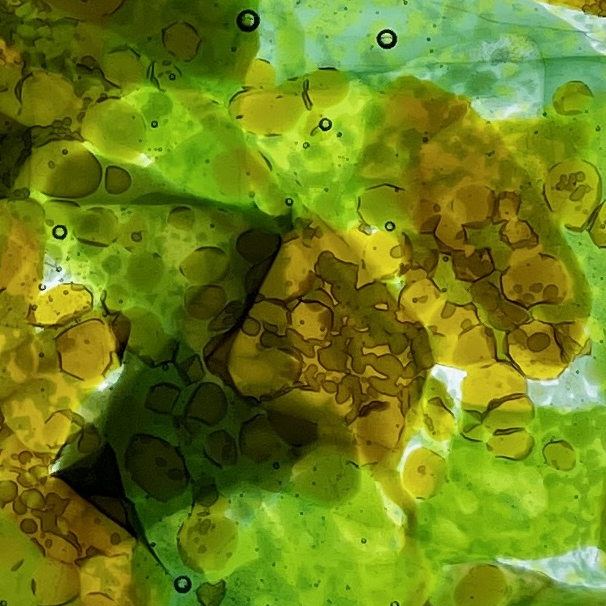
A close look at the halos — defined rings of reaction where chartreuse met the copper-bearing greens.
And here's the beautiful part: the piece isn't finished. I'm going to chunk it up and fuse it again. Because that's the thing about fused glass, you're never locked into a single outcome. You can cut it, recombine it, push it further. Those halos? No longer a happy accident, but something I want to take even further.
The Reaction Starts Here
You don't need fancy equipment for reactive glass work. You just need two reactive-bearing glasses (anything with copper, sulfur, selenium, or lead), a kiln (any kiln you already have will do), and curiosity. The chemistry does the rest. You can layer sheet glass, use frit and stringers, even add silver foil or copper leaf to amplify the effects. Reactions appear right where the materials touch, that's where the magic lives.
Where to Start
If you want to work with reactive glass intentionally, grab Bullseye's Reactive Potential chart. It lists every reactive glass they make and what they'll react with. It's a cheat sheet for pairing: sulfur-bearing glasses with copper-bearing ones, silver foil with anything reactive.
Start with colors you love. Layer them. Fire them. See what happens. Take notes. The small experiments teach you way more than any chart because you'll see the actual halos, shifts, and color changes your kiln produces with your color combinations.
The Bottom Line
Reactive glass isn't mysterious. It's chemistry. It's predictable in its own way once you understand the rules. But the results, those little pops of unexpected color, those halos and color shifts where two glasses meet, that's pure magic. And that's why it matters.
I'm definitely playing with Chartreuse reactions again.
What reactive glasses do you like to put together? Drop them in the comments. I want to know what surprised you in the kiln.